Does Using an EOR Decrease Your Staffing Firm’s Valuation?
Recruiters often ask: “If I use BOSS as my Employer of Record, will it hurt my valuation?” Let’s unpack the numbers and show how EOR actually positions your firm for higher multiples, not lower.
No, EOR Does Not Decrease Your Valuation
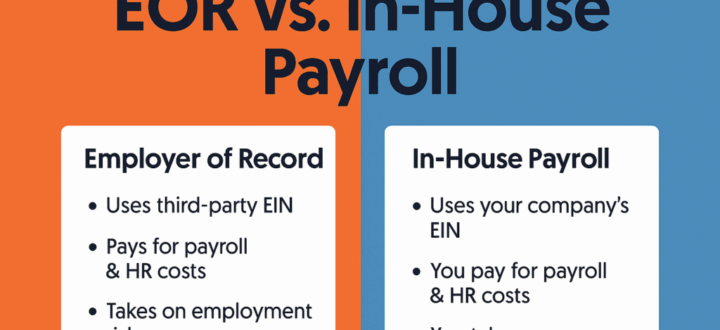
The short answer: using an EOR does not reduce your valuation. When you run contractors through BOSS, you still recognize the sales in your financials. On your P&L, those dollars show up as “revenue under management” (or gross sales). Then, just as if you were running payroll in-house, you record the cost of goods sold — in this case, wages, taxes, insurance, and EOR service fees.
What’s left is your gross margin (the markup you keep), which flows into your operating profit after overhead. Buyers care about recurring gross margin and profitability — not whether you used an EOR or your own payroll platform.
- You still report contract staffing sales as revenue.
- You still show recurring gross margin.
- You still qualify for the higher multiples that contract/temp firms receive (5–8x EBITDA).
The only difference is who carries the payroll risk and working capital burden. With BOSS, you outsource that risk, but the economic story remains the same.
The Real Cost of Doing It Under Your Own EIN
If you decide to put contractors under your own EIN, here’s what you need to budget for:
- Payroll burden: ~20–25% on top of wages (FICA, FUTA/SUTA, workers’ comp, benefits, admin overhead).
- Workers’ comp insurance: 3–7% of payroll depending on state and job class (much higher in healthcare/industrial).
- Software: Onboarding, timecards, payroll, invoicing, collections — expect $2K–$5K per month for an integrated system.
- Payroll funding: Covering $100K in weekly payroll requires $400K+ in cash or credit availability.
- Compliance risk: Misclassification, ACA reporting, wage & hour audits — you assume 100% of liability.
Bottom line: Running contractors under your own EIN is capital-intensive, risk-heavy, and operationally complex.
The BOSS Advantage: EOR or White-Label
With BOSS, you don’t need to choose between valuation and control. We offer two models:
- Full EOR: BOSS is employer of record. We carry payroll, workers’ comp, ACA compliance, onboarding, invoicing, collections, and risk. You focus on recruiting and client management.
- White-Label: Want everything under your brand and EIN? BOSS can power it behind the scenes. You get branded onboarding portals, benefits admin, timecard and payroll management, invoicing, credit checks, and compliance guardrails — all while we manage the complexity.
This means you keep the look and feel of running it yourself while offloading the back-office liability and funding headaches.
Takeaway
Whether you run payroll under your EIN or through BOSS, buyers value your firm on recurring contract staffing gross margin. Using BOSS does not decrease your valuation — it accelerates your ability to grow into the higher-multiple category without tying up capital or taking on extra risk.
Next Step: Explore BOSS White-Label EOR Solutions to scale your staffing business with the branding, economics, and compliance support you need.
DIY vs BOSS — Cost Comparison
Illustrative ranges for a U.S. staffing firm running contract workers. Use this to frame the conversation with owners, ops, or finance. (Not legal/financial advice.)
| Line Item | DIY (Your EIN) | BOSS EOR | Notes |
|---|---|---|---|
| Payroll Burden (FICA, FUTA/SUTA, admin) | ~12–16% of payroll | Included in EOR rate | Varies by state & wage base |
| Workers’ Comp Insurance | ~3–7% (light/clerical) — higher for risk classes | Included in EOR rate (with COIs) | Class code + state drive cost |
| Benefits Administration | Platform + admin $300–$1,000/mo (varies) | Included / optional via EOR | ACA tracking adds overhead |
| Back Office Software (onboarding, time, pay/bill, AR) | $2,000–$5,000/mo | Included (API-first / white-label) | Integration & support included with BOSS |
| Payroll Funding / Working Capital | Line of credit or factoring ~1–4%/30 days; need 4–6 weeks of float | Included (EOR funds payroll; invoices your client) | Removes cash crunch risk |
| Credit & Collections | Internal AR staff + tools | Included (credit checks, invoicing, collections) | BOSS handles NOA if applicable |
| Compliance & COIs (multi-state, OT rules) | Internal expertise + legal review as needed | Included (EOR guardrails + certificates) | Major time saver & risk reducer |
| Total Effective Cost | Burden ~20–25% + WC% + software + funding + overhead | Single EOR rate (bundled) | BOSS can also run white-label on your EIN |
Ballpark Scenario (Simple Illustration)
Assume weekly payroll = $100,000, clients pay on net-45, light/clerical class codes.
DIY (Your EIN)
- Burden (tax/admin) ~14% → $14,000/wk
- Workers’ Comp ~4% → $4,000/wk
- Software → ~$3,000/mo
- Funding cost ~1.5%/30d on $450k avg A/R → ~$6,750/mo
- AR/Collections staff → varies
Plus you must carry ~$400k–$600k working capital to float payroll.
BOSS EOR
- Single EOR rate includes taxes, WC, funding, compliance
- Time, pay, bill, and collections included
- API/white-label options; your branding maintained
No working-capital float; BOSS advances payroll and bills your client.
Footnotes: Ranges are illustrative and vary by state, class code, debtor mix, terms, and volume. Buyers typically value firms on recurring gross margin/EBITDA; using an EOR does not reduce valuation—revenue appears as “revenue under management,” COGS (including EOR fees) flows to gross margin, then operating profit.