The BOSS Guide
Employer of Record Payroll Services: The Complete Guide for Staffing Firms
Everything you need to know about how EOR payroll works, what it includes, what it costs, and how to choose the right provider for your staffing firm.
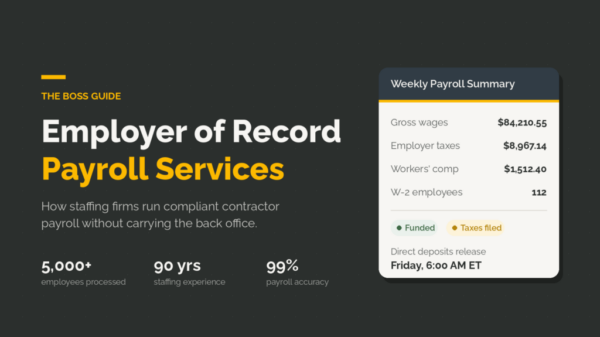
Employer of record payroll services let a staffing firm place W-2 contractors without becoming the legal employer, running payroll in house, or carrying the compliance burden that comes with either. The EOR becomes the legal employer of your placed workers, processes their payroll, files the taxes, carries the workers’ compensation coverage, and handles unemployment claims, while you keep the client relationship and the margin. This guide breaks down exactly how it works and what to look for in a provider.
In This Guide
- What are employer of record payroll services?
- How EOR payroll works, step by step
- What a full-service EOR payroll solution includes
- EOR payroll vs. in-house payroll vs. PEO
- Who uses EOR payroll services
- What employer of record payroll services cost
- How to choose an EOR payroll provider
- Frequently asked questions
What Are Employer of Record Payroll Services?
An employer of record (EOR) is a company that becomes the legal W-2 employer of your workers while those workers perform their jobs for you and your clients. Employer of record payroll services are the operational core of that arrangement: the EOR onboards each worker, runs weekly payroll, withholds and remits payroll taxes in every state where your people work, issues W-2s at year end, and carries the workers’ compensation and unemployment insurance in its own name.
For staffing firms, this solves the single biggest barrier to placing contractors. You can say yes to contract and temp business without registering as an employer in new states, opening tax accounts, securing workers’ comp policies, or hiring a back-office team. Our guide to back office support services for staffing firms covers everything that layer includes. For a deeper look at the EOR model itself, see our full Employer of Record guide.
How EOR Payroll Works, Step by Step
- You make the placementYou find the client, negotiate the bill rate, and select the candidate. The client relationship stays 100% yours.
- The EOR onboards the workerThe worker completes W-4, I-9, direct deposit, and any client-required screening through the EOR’s onboarding workflow.
- Time is captured and approvedHours flow in through timesheets or a client VMS, are approved, and feed directly into the payroll run.
- Payroll runs and taxes are filedThe EOR pays the worker as its W-2 employee, withholds and remits all federal, state, and local taxes, and covers workers’ comp.
- Your client is invoiced, you keep the spreadThe EOR invoices the client at your bill rate, collects payment, and remits your margin, minus its fee.
What a Full-Service EOR Payroll Solution Includes
Not every provider covers the same ground. A complete employer of record payroll service should include all of the following, without add-on pricing surprises:
Payroll funding is the other half of the equation for many firms. Because contractors are paid weekly and clients pay in 30 to 60 days, someone has to float that gap. Many EOR providers, including BOSS, offer payroll funding as part of the service, so the cash-flow gap never touches your bank account. For every funding option compared side by side, see our staffing agency funding guide.
EOR Payroll vs. In-House Payroll vs. PEO
Staffing firms usually weigh three paths. Here is how they compare on the dimensions that matter:
| EOR Payroll Services | In-House Payroll | PEO | |
|---|---|---|---|
| Legal employer of workers | The EOR | Your firm | Co-employment (shared) |
| State registrations and tax accounts | None required by you | You, in every state | Typically still you |
| Workers’ comp policy | Carried by the EOR | You secure and pay | PEO master policy |
| Payroll funding available | Often built in | You self-fund or borrow | Rarely offered |
| Client invoicing and collections | Included | You handle | Not included |
| Best fit | Staffing and recruiting firms | Large established agencies | Companies with permanent staff |
The short version: a PEO is built for companies managing their own permanent employees, while an EOR is built for firms placing workers at client sites. If your revenue comes from placements, the EOR model removes the most risk with the least overhead. For a fuller comparison of every employment model, see our guide to EOR vs PEO vs AOR, and for a detailed look at the processing side alone, see our payroll processing overview.
Who Uses EOR Payroll Services?
- Recruiting firms adding contract placements to a permanent-placement business for the first time
- Established staffing agencies expanding into new states without new registrations
- Independent recruiters who want contract revenue without building a back office
- Staffing firms whose clients require a W-2 arrangement instead of 1099 contractors (our guide to W-2 vs 1099 vs C2C explains the difference)
- Agencies that want to offload payroll funding, invoicing, and collections in one move
What Do Employer of Record Payroll Services Cost?
Most EOR providers price as a percentage of payroll or a markup on the pay rate, and the right structure depends on how much of the back office you want to hand off. Some firms only need processing and tax filing. Others want funding, invoicing, collections, and full EOR employment in a single bundle. That is why BOSS offers four operating models, the Core Plan, the Funded Plan, the Self-Funded EOR, and the Complete Plan, so you only pay for the layers you actually use.
How to Choose an EOR Payroll Provider
Vet any employer of record payroll provider against this checklist before you sign:
- Staffing-industry focus, not a generic payroll bureau that treats contractors as an afterthought
- All 50 states covered, with taxes filed under the EOR’s own accounts
- Payroll funding available so weekly payroll never strains your cash flow
- Invoicing and collections handled at your bill rate, with clear margin reporting
- A real portal where you can see payroll, invoices, and aging in one place
- Transparent pricing with no per-state, per-filing, or year-end surprise fees
- A track record you can verify, with references from firms like yours
Why Staffing Firms Choose BOSS
Back Office Staffing Solutions was built by staffing-industry veterans with 90 years of combined experience. We have processed payroll for more than 5,000 employees with 99% payroll accuracy, and our four operating models mean you can start with exactly the level of support you need and change it as you grow.
Employer of Record Payroll Services: FAQ
Is an employer of record the same as a payroll company?
No. A payroll company processes payroll under your legal employer accounts, so registrations, workers’ comp, and liability stay with you. An employer of record becomes the legal employer itself, so those obligations move to the EOR while you direct the work.
Who is the legal employer when I use EOR payroll services?
The EOR is the legal W-2 employer. Your workers are paid on the EOR’s tax accounts and covered by the EOR’s workers’ compensation and unemployment insurance, while you and your client direct their day-to-day work.
Do I lose my client relationships when an EOR invoices them?
No. Clients remain yours. The EOR handles the administrative invoicing and collections at the bill rate you set, and your margin is remitted to you.
Can an EOR pay workers in states where my firm is not registered?
Yes. That is one of the core advantages. Because the EOR is the legal employer, it uses its own registrations and tax accounts, so you can place workers in any state immediately.
How fast can I get started with employer of record payroll services?
With BOSS, most firms can onboard their first contractor within days. Setup consists of a service agreement and worker onboarding, with no state registrations or insurance procurement on your side.
Ready to place contractors without the back office?
Talk with our team about which of the four BOSS operating models fits your firm.