Insurance Guide
Insurance for Staffing Agencies: What You Need and Who Carries It
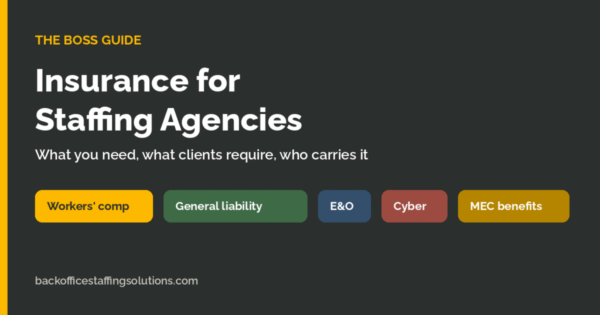
Staffing firms carry more insurance exposure per dollar of revenue than almost any other small business: your people work inside other companies’ walls, under their direction, in every state you place. This guide covers the coverage staffing agencies need, what clients require before a worker walks in the door, and how an employer of record changes who carries the burden.
Insurance for staffing agencies is not one policy. It is a stack of coverages, some legally required, some contractually required by clients, and some just prudent. Which of them your firm has to buy depends on one question: are you the legal employer of your placed workers, or is an employer of record the employer on your behalf?
The Insurance Stack Every Staffing Agency Needs
| Coverage | What it protects against | Who requires it | With BOSS as EOR |
|---|---|---|---|
| Workers’ compensation | Workplace injuries to placed workers | State law, every client MSA | Carried by BOSS |
| General liability | Third-party bodily injury and property damage | Nearly every client contract | Carried by BOSS |
| Professional liability (E&O) | Claims of negligent work or placement errors | Many clients, especially IT and healthcare | Carried by BOSS |
| Cyber liability | Data breaches involving worker and client data | Increasingly common in MSAs | Carried by BOSS |
| Unemployment insurance | Statutory SUTA and FUTA obligations | Federal and state law | Carried by BOSS as the employer |
| Health benefits (MEC) | ACA compliance and worker retention | ACA rules at scale; workers expect it | Offered through BOSS’s benefits administration |
What Clients Actually Check: The COI
Before a placed worker starts, most clients require a certificate of insurance (COI) naming them as certificate holder and often as additional insured, showing workers’ comp, general liability, and sometimes professional liability at specified limits. If you cannot produce a compliant COI quickly, the start date slips and the placement is at risk. When BOSS is the employer of record, certificates of insurance are issued from BOSS’s policies, tailored to your client’s requirements, without your firm shopping for coverage.
The Two Paths: Carry It Yourself or Use an EOR
Path 1: You remain the employer
On BOSS’s Core and Funded Plans, your firm is the legal employer of your placed workers, which means the employment insurance stack is yours: your workers’ comp policy (rated by class code and state), your unemployment accounts, and the general and professional liability your clients require. This is a legitimate path for firms that want to own employment, and BOSS supports it with payroll, compliance, and back-office automation. Budget real money and real time for it: comp premiums are driven by your workers’ comp class codes, and misclassified codes are one of the most expensive mistakes in staffing. Our guide to classifying workers’ comp codes for your staffing agency explains how those codes work.
Path 2: BOSS is the employer of record
On the Self-Funded EOR and Complete Plans, BOSS is the legal employer of your placed workers, and the insurance stack above is carried by BOSS: workers’ compensation, general liability, professional liability, cyber coverage, and statutory unemployment obligations, with COIs issued to your clients on request. If you are weighing this model against a PEO or an AOR arrangement, our EOR vs PEO vs AOR comparison breaks down who carries what under each. Your firm does not have to purchase coverage for placed workers at all. Many firms still choose to keep a modest general liability policy, and sometimes professional liability, for their own corporate operations, and we think that is sensible. But the employment-side burden, the part that scales with every placement, sits with BOSS.
What Insurance Costs a Staffing Agency
Costs vary widely by state, class code, and payroll volume, which is why generic quotes mislead. The drivers are consistent: workers’ comp premium is a percentage of payroll set by class code and your experience rating; general liability and E&O scale with revenue and industry; unemployment tax rates ride on your claims history. Clerical placements cost a fraction of light-industrial or healthcare placements to insure. The practical takeaway: insurance cost is one of the strongest financial arguments for the EOR model, because an EOR spreads these costs across a large pooled workforce instead of a single small firm’s book.
Benefits Are Part of the Picture
Insurance protects your firm; benefits keep your workers. Contract workers increasingly expect access to health coverage, and ACA rules apply once employer size thresholds are crossed. BOSS offers placed W-2 employees access to medical, dental, and vision coverage through its benefits administration, which keeps assignments ACA-compliant and gives your recruiters a real answer when candidates ask about benefits. Our full guide to health insurance for staffing agencies covers the plans, costs, and enrollment in detail.
Want the placement-side insurance burden off your books?
Tell us what your clients require and we’ll show you exactly what BOSS carries and what a COI looks like, in one conversation.
Insurance for Staffing Agencies FAQs
Does an employer of record provide insurance?
Yes. When BOSS acts as the employer of record, BOSS carries workers’ compensation, general liability, professional liability, cyber coverage, and statutory unemployment obligations for placed workers, and issues certificates of insurance to your clients.
What insurance does a staffing agency need?
The core stack is workers’ compensation, general liability, professional liability (E&O), and statutory unemployment coverage, plus cyber liability increasingly often. Client contracts typically specify required coverages and limits, verified by COI before a worker starts.
Do I still need my own insurance if I use an EOR?
For placed workers, no: the EOR carries the employment stack. Many firms keep a modest general liability policy, and sometimes professional liability, for their own corporate operations, which we consider sensible but which is far cheaper than insuring a placed workforce.
What is a COI and why do clients ask for one?
A certificate of insurance is proof of coverage listing policy types, limits, and the certificate holder. Clients require one before assignments begin to confirm workers’ comp and liability coverage exists. With BOSS as EOR, COIs are issued from BOSS’s policies on request.
How much does workers’ comp cost for a staffing agency?
Premiums are a percentage of payroll determined by workers’ comp class codes, state rates, and your experience modifier. Clerical codes cost a fraction of industrial or healthcare codes, which is why accurate code classification matters so much to staffing margins.
Do staffing agencies have to offer health benefits?
ACA employer rules apply once size thresholds are crossed, and many clients and candidates expect benefits access regardless. BOSS offers placed W-2 employees access to a Minimum Essential Coverage (MEC) plan through its benefits administration.
Related reading: the right insurance for your staffing business and how workers’ compensation works.