The BOSS Guide
Factoring for Staffing Companies: How It Works and What It Really Costs
Advance rates, reserves, recourse clauses, and the fee traps hiding in factoring agreements. Plus the honest comparison with payroll funding, so you pick the right tool for your agency.
Factoring for staffing companies is one of the oldest funding tools in the industry: you sell your unpaid client invoices to a factoring company at a discount, get most of the cash immediately, and receive the rest when your client pays. Staffing is one of the most factored industries in America because the mismatch is built in, weekly payroll against invoices that pay in 30 to 60 days. Whether you call it staffing invoice factoring, payroll factoring, or receivables factoring, the mechanics are the same, and this guide explains exactly how it works, what it costs, and where it falls short.
In This Guide
How Factoring Works for Staffing Companies, Step by Step
- You sign a factoring agreementThe factor approves your clients based on their credit, sets an advance rate, and files a UCC lien on your receivables.
- You run payroll and invoice your clientPayroll, taxes, workers’ comp, and invoicing all remain your responsibility. The factor only touches the invoice.
- You submit the invoice for an advanceThe factor advances 85 to 95% of the invoice value, usually within a day. The remainder is held in reserve.
- Your client pays the factorPayment goes to the factor’s lockbox, not to you. Clients receive a notice of assignment directing payment there.
- You receive the reserve, minus the feeWhen the invoice is collected, the factor releases the held reserve and deducts its factoring fee.
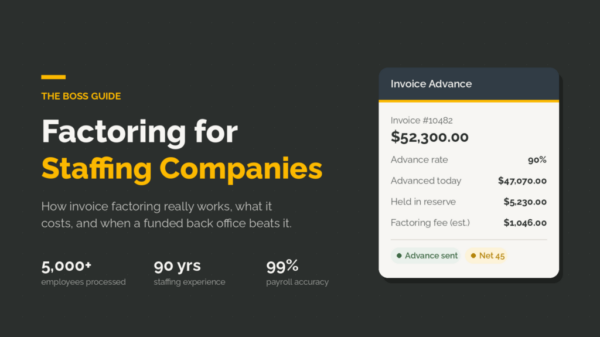
Worked example: on a $52,300 invoice at a 90% advance rate, you receive $47,070 up front. If your client pays on day 45 and the fee works out to 2%, you get the $5,230 reserve back minus a $1,046 fee. You bore the payroll work and the tax filings; the factor bore the wait.
Recourse vs. Non-Recourse Factoring
The single most important line in any factoring agreement is who eats the loss if your client never pays:
Practical takeaway: non-recourse is narrower than it sounds. If a client refuses to pay over a billing dispute, most non-recourse agreements push that invoice back to you anyway. Price the difference accordingly.
What Does Factoring Cost for Staffing Companies?
Staffing factoring fees typically run 1 to 4% of invoice value, structured one of two ways: a flat discount for a set period, or a tiered rate that grows the longer the invoice is outstanding, for example 1.5% for the first 30 days plus 0.5% per 10 days after. On net-45 clients, a 2% all-in fee is roughly a 16% annualized cost of capital. That is far cheaper than a merchant cash advance and far more expensive than a bank line, which is exactly why factoring lives in the middle.
The headline rate is rarely the whole bill. Ask about every one of these before signing:
- Origination or due diligence fees at signing
- Monthly minimum volume fees if you factor less than projected
- Per-invoice processing, ACH, or wire fees
- Reserve release timing, some factors hold reserves for weeks after collection
- Early termination fees and auto-renewal clauses
- Float days, where the factor holds client payments a few days before crediting them, extending your fee period
Factoring vs. Payroll Funding: The Comparison That Matters
For staffing agencies, the real alternative to factoring is not a bank loan. It is payroll funding, where a staffing-specific funder pays your weekly payroll directly and handles the back office around it. The money problem is solved either way; the difference is everything else:
| Payroll Funding | Invoice Factoring | |
|---|---|---|
| What gets funded | Your payroll and payroll taxes, directly | An advance against your invoices |
| Payroll processing and tax filing | Included | You handle, or hire separately |
| Invoicing and collections | Included | Collections only, you still invoice |
| Workers’ comp | Available through the program | You secure your own policy |
| Employment liability option | Yes, with employer of record coverage | No |
| Built for | Staffing agencies specifically | Any B2B business with invoices |
| Your remaining back-office workload | Minimal | Nearly all of it |
A factor gives you an advance and then hands the invoice problem back to your office. For the full landscape of options, see our staffing agency funding guide. Payroll funding through a staffing back office covers the payroll itself and removes the work that surrounds it: processing, filings, invoicing, and collections. If you also want the employment liability off your books, the same structure extends to full employer of record coverage. See our payroll funding guide for the full mechanics.
Red Flags in Staffing Factoring Agreements
- All-invoice requirements that force you to factor every client, including the ones who pay in 15 days
- Recourse periods shorter than your clients’ actual payment behavior
- Non-recourse marketing with a covered-events list limited to bankruptcy only
- Reserve holds that continue after the client has paid
- Termination fees calculated on projected volume rather than actual volume
- Verification calls to your clients that are really disguised collection pressure
- No staffing industry references, a generalist factor learning payroll timing on your account
Why Staffing Firms Choose BOSS
Back Office Staffing Solutions was built by staffing veterans with 90 years of combined experience, and we solve the funding problem the staffing-specific way: payroll funding bundled with weekly payroll, tax filing, invoicing, and collections, with employer of record coverage available when you want the liability handled too. We have processed payroll for more than 5,000 employees with 99% payroll accuracy. Funding is built into the Funded Plan and the Complete Plan.
Factoring for Staffing Companies: FAQ
Will my clients know I am factoring?
Yes. Factoring is notification-based: your clients receive a notice of assignment and pay the factor directly. This is completely normal in staffing and rarely raises concerns, but it is not invisible.
Can a startup staffing agency qualify for factoring?
Usually, yes. Like payroll funding, factoring approval is based primarily on your clients’ credit rather than your operating history, which is why both are common first funding tools for new agencies.
What advance rate should a staffing company expect?
Staffing invoices are considered high quality collateral, so advance rates typically run 85 to 95%. Rates at the higher end usually come with strong client credit and clean invoicing history.
Does factoring cover my payroll taxes and workers’ comp?
No. A factor advances cash against invoices, but running payroll, remitting taxes, filing in each state, and carrying workers’ comp all remain your responsibility. That is the core difference from payroll funding, which handles those directly.
Is factoring or payroll funding better for a staffing agency?
If you already have a payroll department and just need cash, factoring works. If you would rather not run payroll, file taxes, invoice, and chase collections at all, payroll funding bundles the money with the back office and usually wins on total cost of ownership.
Get the funding without inheriting the paperwork
Talk with our team about the Funded Plan and see what a bundled back office actually costs.