The BOSS Guide
Employer of Record vs. Staffing Agency: What’s the Difference?
One finds the talent. The other legally employs it. Here is exactly how the two models differ, where they overlap, and why the smartest staffing agencies use an EOR instead of competing with one.
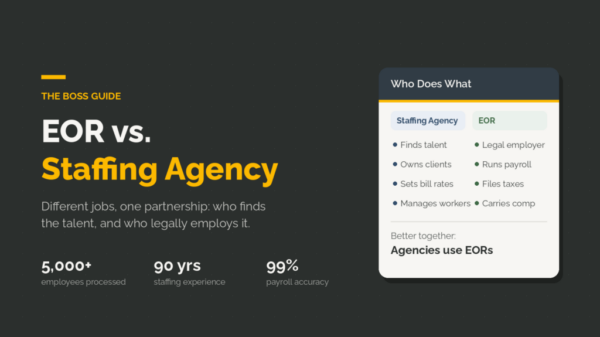
The short answer: a staffing agency finds, vets, and places workers with client companies and owns those client relationships. An employer of record (EOR) becomes the legal W-2 employer of workers someone else has already found, handling payroll, taxes, workers’ compensation, and compliance. A staffing agency answers “who should we hire?” An EOR answers “who employs them, pays them, and carries the risk?” They are not competitors. In fact, thousands of staffing agencies use an EOR as their back office, and that combination is what this guide unpacks.
In This Guide
What a Staffing Agency Does
A staffing agency is a talent business. It sources candidates, screens and vets them, matches them to client openings, negotiates bill rates, and manages the ongoing client relationship. Revenue comes from placement fees on permanent hires and hourly margin on contract placements. When an agency places contractors, it also inherits a second job it never asked for: legally employing them, which means payroll, tax accounts in every work state, workers’ comp, unemployment claims, invoicing, and collections. That second job is where the EOR enters the picture.
What an Employer of Record Does
An employer of record is an employment infrastructure business. It becomes the legal W-2 employer of workers that another company has recruited and directs. The EOR onboards each worker, runs weekly payroll, withholds and files taxes under its own accounts, carries workers’ compensation and unemployment insurance, and handles compliance across states. The EOR does not find talent, does not own the client relationship, and does not direct the work. For the complete breakdown of the model, see our Employer of Record guide.
EOR vs. Staffing Agency, Side by Side
| Staffing Agency | Employer of Record | |
|---|---|---|
| Finds and vets talent | Yes, core business | No |
| Owns the client relationship | Yes | No |
| Legal W-2 employer | Only if it self-employs placements | Yes, always |
| Runs payroll and files taxes | Only if built in house | Yes, on its own accounts |
| Carries workers’ comp | Only if self-employing | Yes |
| Directs the day-to-day work | With the client, yes | No |
| Revenue model | Placement fees and hourly margin | Service fee on payroll |
| Typical customer | Companies that need people | Companies that have people to employ |
The Real Answer: Staffing Agencies Use EORs
Here is what the versus framing misses. Because the two models answer different questions, they combine cleanly: the staffing agency does what it is great at, recruiting and client relationships, and the EOR quietly runs employment underneath. The agency places a contractor; the EOR employs that contractor, pays them weekly with employer of record payroll services, files the taxes, carries the comp, invoices the client at the agency’s bill rate, and remits the margin. Many EOR programs, including BOSS, also fund the payroll, so the agency never floats the gap between Friday paychecks and net-45 invoices.
The practical result: a recruiting firm can add contract placements without registering as an employer anywhere, and a growing agency can expand into new states the day a client asks, not after months of registrations. That is why the fastest-growing small agencies treat the EOR question as make-or-buy, and most of them buy.
When You Need Which
- You are a company that needs workers found and vetted: you need a staffing agency.
- You are a recruiter or perm-placement firm that wants contract revenue without becoming an employer: you need an EOR behind your placements.
- You are a staffing agency tired of running payroll, comp, and collections in house: you need an EOR as your back office.
- You already have workers identified and only need them legally employed and paid: you need an EOR, not an agency.
- You are launching a new agency and deciding how to structure employment from day one: start with an EOR and revisit in-house once you pass several hundred contractors. Our guide on how to start a staffing agency walks through that decision.
Why Staffing Firms Choose BOSS
Back Office Staffing Solutions is the EOR built specifically for staffing agencies and recruiters. Built by staffing veterans with 90 years of combined experience, we handle weekly W-2 payroll, multi-state tax filing, workers’ comp, client invoicing, collections, and payroll funding, across four operating models so you use exactly the layers you need. We have processed payroll for more than 5,000 employees with 99% payroll accuracy, while our agency partners keep every client relationship and every point of margin they negotiated.
EOR vs. Staffing Agency: FAQ
Is an employer of record the same as a staffing agency?
No. A staffing agency finds and places talent and owns the client relationship. An employer of record legally employs workers that someone else recruited, handling payroll, taxes, and workers’ comp. Many staffing agencies use an EOR to employ their placements.
Can a staffing agency use an employer of record?
Yes, and it is one of the most common EOR use cases. The agency recruits and manages the client; the EOR employs the placed workers, runs payroll, files taxes, carries comp, and often funds the payroll and handles invoicing as well.
Who is the legal employer when an agency uses an EOR?
The EOR. Placed workers are W-2 employees of the employer of record, paid on its tax accounts and covered by its workers’ compensation, while the agency and its client direct the day-to-day work.
Does using an EOR mean giving up my client relationships or margin?
No. You set the bill rate and own the client. The EOR invoices at your rate, collects, and remits your margin minus its fee. Clients continue working with your firm as they always have.
What does an EOR cost compared to running employment in house?
EORs typically price as a percentage of payroll. Running employment in house means payroll software, state registrations, a workers’ comp policy, staff time, and carrying the cash flow gap yourself. For most agencies under several hundred contractors, the bundled EOR is cheaper in total cost, and it scales instantly into new states.
Keep the clients. Hand off the employment.
Talk with our team about putting BOSS behind your placements.