Employer of Record vs Payroll Company: What Staffing Firms Need to Know
They both help you pay workers, but only one becomes the legal employer, absorbs the compliance risk, and unlocks fast multi-state growth. Here is how to tell which one your firm actually needs.
At first glance, an Employer of Record (EOR) and a payroll company look like the same purchase. Both take payroll admin off your plate. Both calculate wages, withhold taxes, and get people paid on time. But underneath, they are structurally different services, and the difference matters most for staffing and recruiting firms that need speed, multi-state reach, and real compliance coverage.
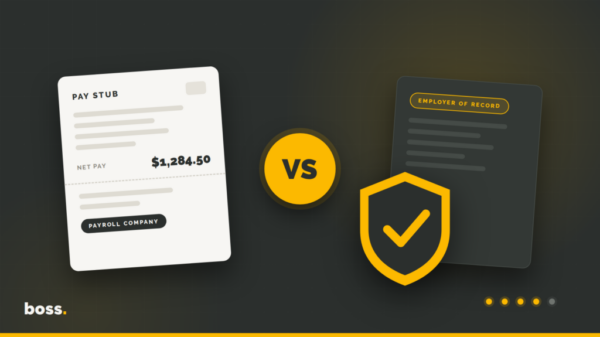
The distinction comes down to one question: whose name is on the employment? A payroll company processes payroll under your accounts, using your employer identification number, your state registrations, and your workers’ compensation policy. An EOR uses its own. Everything else follows from that.
What Is a Payroll Company?
A payroll company gives you tools and services to calculate and deliver payroll. The typical scope looks like this:
- Wage and tax calculations with direct deposit
- Payroll tax filings and year-end forms
- Optional add-ons like timekeeping and basic HR features
The key point: with a payroll company, you remain the legal employer of record. Workers’ comp, wage and hour compliance, and worker classification risk all stay on your books.
That arrangement works well for a company paying its own staff. It works less well for a staffing firm, because every state you place a worker in becomes a state you have to register in, open unemployment accounts in, and carry coverage in. The payroll company will file the returns correctly. It will not open the accounts for you, and it will not answer for what happens if a worker is misclassified.
What Is an Employer of Record?
An EOR becomes the legal employer of record for your W-2 workers. You still run your business, manage your clients, and direct the work. The EOR carries the employment infrastructure:
- W-2 onboarding and employment documents
- Payroll processing and tax filings across states
- Workers’ compensation coverage and certificates of insurance
- Wage and hour, ACA, sick leave, and multi-state compliance
- Often, payroll funding to bridge the gap between paying workers weekly and collecting from clients later
Modern providers like BOSS add an API-first layer on top, so you can embed timecards, payroll, invoicing, and compliance directly into your own ATS or platform instead of bolting on another portal. Our guide to employer of record payroll services walks through what that looks like week to week.
What “EOR Payroll” Actually Means
The phrase gets used loosely, so it is worth being precise. EOR payroll is not a different kind of payroll run. The gross-to-net math, the withholding tables, and the direct deposit file are the same arithmetic either way. What changes is the account those transactions run through.
Under EOR payroll, the worker is hired onto the EOR’s employer identification number. Federal and state withholding is remitted under the EOR’s tax accounts. The quarterly 941 and the state returns carry the EOR’s name. The W-2 issued in January comes from the EOR. Unemployment claims are filed against the EOR’s experience rating, and workers’ compensation claims run through the EOR’s policy.
For the worker, almost nothing looks different: they are directed by your client, they wear your brand, and their paycheck arrives on schedule. For your firm, the difference is that a whole category of liability sits somewhere else.
EOR vs Payroll Company: The Key Differences
| Feature | Payroll Company | Employer of Record |
|---|---|---|
| Legal employer | You | The EOR |
| Payroll processing & tax filings | Included | Included |
| Whose EIN is on the paycheck | Yours | The EOR’s |
| State registrations & SUI accounts | You open and maintain them | Already in place |
| Workers’ comp & COIs | You source and own it | Provided by the EOR |
| Multi-state compliance (wage/hour, sick leave, ACA) | Your responsibility | EOR responsibility |
| 1099 vs W-2 classification guardrails | Limited guidance | Guardrails & policies |
| Unemployment claims | Filed against your rating | Filed against the EOR’s |
| Client invoicing & collections | Not included | Included with some EORs, including BOSS |
| Payroll funding / cash-flow support | Not included | Available with some EORs, including BOSS |
| Time to place in a new state | Weeks to months per state | Immediate |
| Best fit | Established firms with in-house HR and capital | Staffing firms, multi-state programs, capital-light growth |
How the Two Are Priced
Payroll companies typically charge a base fee plus a per-employee-per-pay-run amount, with extras for tax filing in additional states, year-end forms, and add-on modules. The headline number looks small because it only covers processing.
An EOR usually prices as a percentage of payroll or as a markup on the pay rate, and the number looks larger by comparison. The honest way to read that difference is to ask what the payroll company quote leaves out. On the EOR side, the fee typically absorbs workers’ compensation premium, unemployment insurance, state registrations, employment liability, and often invoicing and collections. On the payroll side, each of those is a separate cost you carry directly.
The comparison that actually matters is total loaded cost per hour placed, not vendor invoice against vendor invoice. Add up what you currently pay for payroll processing, workers’ comp premium, unemployment contributions, the software you use to bill clients, and the staff time spent on all of it. That is the number to hold against an EOR quote.
How to Evaluate an EOR Provider
If you decide the EOR model fits, the providers are not interchangeable. Questions worth asking before you sign:
- Whose tax accounts are used? Filings should run under the EOR’s EIN in every work state, not yours.
- Who holds the workers’ comp policy, and what does it cover? Ask to see the classifications and the full insurance schedule, not a summary.
- How fast can they onboard in a state you have never placed in? The answer should be days, not a project plan.
- Is payroll funding available, and on what terms? Weekly pay against net-45 clients is the cash-flow reality of staffing.
- Do invoices carry your brand? Your client relationship should not become theirs.
- Is there an API, or only a portal? If your ATS cannot talk to them, you are re-keying data forever.
- Who answers when payroll breaks on a Thursday night? Ticket queue or a person who understands staffing payroll.
Switching From a Payroll Company to an EOR
The move is smaller than most firms expect, because there is no system to build. Your existing workers are onboarded onto the EOR’s payroll, usually electronically and often within days. Your ATS stays where it is. Client agreements typically need a short amendment naming the EOR as the employer of the placed workers.
Two things do change and are worth planning for. Mid-year transitions mean workers receive two W-2s for that year, one from each employer, which is normal but worth telling them in advance. And your own unemployment experience rating stops accruing on the placed population, which is usually the point.
Many firms keep their payroll company for internal staff while running placed workers through the EOR. That is a perfectly common arrangement, not a compromise.
Which Should You Choose?
Pick a payroll company if…
- You already have legal entities registered everywhere you hire
- You can float weekly payroll without outside financing
- You maintain HR, workers’ comp, and compliance in-house
- Your placements are concentrated in one or two states you know well
Pick an Employer of Record if…
- You need to place workers across states quickly, without setting up entities
- You want to move employer risk, workers’ comp, and compliance off your books
- You are a staffing or recruiting firm adding contract or temp placements and want API-powered, white-label workflows
- Cash flow is tight, so you want an EOR that includes payroll funding
Worth noting that these are not the only two options. A PEO shares employment with you through co-employment and is built for a company’s internal staff rather than placed workers, and an AOR handles engagement for legitimate 1099 contractors without employing anyone. Our EOR vs PEO vs AOR comparison covers where each one fits.
TL;DR
A payroll company cuts checks. An EOR becomes the employer, removes the risk, and often adds funding and multi-state reach. For most staffing firms, the EOR is the right call.
FAQ
Is an employer of record the same as a payroll company?
No. A payroll company processes payroll under your employer accounts, so registrations, workers’ compensation, and employment liability stay with you. An employer of record becomes the legal employer itself, so those obligations move to the EOR while you keep the client relationship and direct the work.
What does EOR payroll mean?
EOR payroll means the worker is paid under the employer of record’s tax accounts rather than yours. The EOR’s EIN appears on the paycheck, it remits federal and state withholding, files the quarterly returns, and issues the W-2 at year end. The payroll math is identical; the accounts it runs through are not.
Is an EOR more expensive than a payroll company?
The invoice is usually higher, but it is not the same purchase. An EOR fee typically absorbs workers’ compensation premium, unemployment insurance, state registrations, and employment liability, all of which you pay separately when using a payroll company. Compare total loaded cost per hour placed rather than one vendor invoice against another.
Can we keep our ATS and accounting system?
Yes. An EOR sits behind the scenes as the employment and payroll layer, so your front office stays exactly as it is. BOSS is built API-first, which means timecards, payroll, invoicing, and compliance data can flow into the ATS and accounting tools you already use.
What about 1099 contractors?
An EOR provides W-2 employment. For 1099 engagements, the safe path is strict screening and documentation before anyone starts work. BOSS also offers tools to assess classification risk and supports compliant engagement paths so you are not guessing on who qualifies.
Does an EOR replace our payroll company?
For W-2 contract and temp workers, yes. The EOR runs payroll, files taxes, and carries the employment liability, so a separate payroll vendor is not needed for those placements. Many firms keep their existing payroll provider for internal staff and use the EOR for placed workers.
How long does it take to switch to an EOR?
Days rather than weeks in most cases, because the employment infrastructure already exists. Workers onboard electronically onto the EOR’s payroll, your ATS stays where it is, and client agreements usually need only a short amendment naming the EOR as employer of the placed workers.
Will my workers get two W-2s if we switch mid-year?
Yes, one from your firm covering wages paid before the transition and one from the EOR covering wages after. This is normal and expected when employment changes hands during a calendar year, but it is worth telling workers in advance so the second form is not a surprise.
Ready to see where your firm fits?
BOSS offers four plans, from back-office software to full Employer of Record with payroll funding.