The BOSS Guide
Staffing Agency Funding: Every Option Compared
Contractors get paid every Friday. Clients pay in 30 to 60 days. This guide covers every way to fund that gap, what each option really costs, and how to pick the right one for your firm.
Staffing agency funding exists because of one brutal math problem: you pay your contractors weekly, but your clients pay their invoices in 30, 45, or 60 days. Every placement you make means weeks of payroll leaving your account before a single client dollar arrives. The faster you grow, the wider that gap gets. Here is every realistic way to close it, compared honestly.
In This Guide
The Cash Flow Gap, in Real Numbers
Say you place 10 contractors at a $35 pay rate working 40 hours a week. That is $14,000 in gross wages every Friday, plus roughly $1,700 in employer taxes and workers’ comp. Call it $15,700 a week out the door. If your client pays on net-45 terms, you will float about seven payroll cycles, more than $109,000, before the first invoice is collected. Add a second client and the number doubles.
That is why funding is not a sign of weakness in staffing. It is structural. Nearly every growing agency uses some form of it, and the firms that stall are usually the ones that tried to self-fund past their limit and had to turn down placements they could not float.
Staffing Company Funding Options Compared
There are five realistic ways to fund a staffing company. Each solves the same gap with very different costs, risks, and admin burdens:
| Payroll Funding / Funded EOR | Invoice Factoring | Bank Line of Credit | Self-Funding | |
|---|---|---|---|---|
| Covers weekly payroll | Yes, directly | Indirectly, you run payroll | Indirectly | Yes, from your cash |
| Back office included | Yes: payroll, taxes, invoicing, collections | No | No | No |
| Approval based on | Your clients’ credit | Your clients’ credit | Your financials and history | Your bank balance |
| Works for new agencies | Yes | Yes | Rarely | Only at small scale |
| Growth ceiling | Scales with placements | Scales with invoices | Fixed credit limit | Your cash on hand |
| Typical cost basis | Percentage of payroll or bill rate | 1 to 4% of invoice value | Prime plus margin | Opportunity cost |
The pattern to notice: factoring and bank credit give you money but leave you running payroll, filing taxes in every state, carrying workers’ comp, and chasing collections, the entire staffing back office, still on your plate. Payroll funding and a funded EOR give you the money and take the work. For most staffing agencies under roughly $20M in revenue, that bundle is worth more than the rate difference.
How Payroll Funding Works, Step by Step
- Your clients are credit-checkedApproval is based on your clients’ ability to pay, not your balance sheet. New agencies qualify on day one with creditworthy clients.
- Timesheets come in, payroll goes outThe funder pays your contractors and the associated payroll taxes every week from its own capital.
- Clients are invoiced at your bill rateProfessional invoices go out under the agreed terms, and collections are handled for you.
- Clients pay, you receive your marginWhen the invoice is collected, your gross margin is remitted to you, minus the funding fee.
For the full mechanics, including how funding pairs with back-office processing, see our payroll funding guide. And if you want the employment liability handled too, the same structure is available with full employer of record coverage, where the funder is also the legal W-2 employer of your contractors.
What Does Staffing Agency Funding Cost?
Most staffing agency funding is priced as a percentage of payroll or of the invoice, and the honest answer is that the rate is only half the equation. The other half is what you no longer pay for: payroll software, a payroll administrator, state registrations, workers’ comp deposits, invoicing time, and collection calls. A standalone factor at a lower headline rate can easily cost more in total than a funded back office at a higher one.
Questions that determine your real cost:
- Is the fee on payroll or on the invoice? The same percentage means very different dollars on each base.
- Are payroll processing, tax filing, invoicing, and collections included, or billed separately?
- Are there monthly minimums, per-invoice fees, or termination penalties?
- Is the arrangement recourse or non-recourse if a client fails to pay?
- Does the rate drop as your volume grows?
How to Choose a Staffing Funding Partner
- Staffing-industry specialization, not a generalist factor that happens to take staffing clients
- Funding bundled with payroll, tax filing, invoicing, and collections, so you are not stitching vendors together
- Approval driven by client credit, so a new agency is not penalized for being new
- No cap that forces you to decline placements during a growth spurt
- Transparent remittance reporting, so you can see margin by placement and by client
- The option to add employer of record coverage as you expand into new states
- References from agencies at your size and in your vertical
Why Staffing Firms Choose BOSS
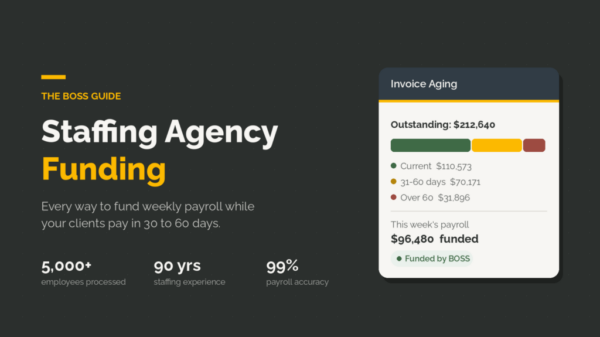
Back Office Staffing Solutions combines payroll funding with the entire back office: weekly payroll, tax filing, invoicing, collections, and optional employer of record coverage. Built by staffing veterans with 90 years of combined experience, we have processed payroll for more than 5,000 employees with 99% payroll accuracy. Start on the Funded Plan and change models as you grow.
Staffing Agency Funding: FAQ
Can a brand-new staffing agency get funding?
Yes. Payroll funding approval is based on your clients’ credit, not yours. If you have a signed placement with a creditworthy client, you can typically be funded from your first payroll, even with no operating history.
What is the difference between payroll funding and invoice factoring?
Factoring advances you cash against invoices and stops there. Payroll funding pays your payroll and taxes directly and usually includes processing, invoicing, and collections. Factoring gives you money; payroll funding gives you money plus the back office.
Do my clients know I use funding?
Clients receive invoices and remit payment as part of the arrangement, which is standard across the staffing industry. Their day-to-day relationship, rates, and point of contact remain entirely with you.
What happens if my client does not pay?
It depends on whether your agreement is recourse (you are ultimately responsible for the unpaid invoice) or non-recourse (the funder absorbs qualifying credit losses). Always confirm which structure you are signing and what events are covered.
Is staffing company funding worth it for a small agency?
Usually, yes. Small agencies feel the payroll gap hardest, and bundled funding removes both the cash strain and the back-office workload at the stage when you can least afford staff for either. The alternative, capping growth at what you can self-fund, usually costs more than the fee.
Stop turning down placements you cannot float
Talk with our team about the Funded Plan and get your next payroll funded.